THE SHORT ANSWER
AI assistants tend to cite pages they can read, understand and trust: specific, factual, original and consistent. Structured data labels the business clearly for the systems that use it.
Louisville Historic Tours got there with one page per tour, original stories stated as facts, schema on every page and a booking path that works.
More of your customers now ask an AI assistant before they search. “What is the best ghost tour in Louisville?” “Who should I hire for a kitchen remodel near me?” The answer they get names a few businesses. If yours is not one of them, you never got a chance to compete.
Louisville Historic Tours now holds the first organic result for “ghost tour louisville,” and Google’s AI Overview names its walking tour the top-rated in the city. Here is what we changed, and the pattern any local business can copy.
How AI answers choose who to name
Assistants like ChatGPT, Perplexity and Google’s AI Overviews pull from pages they can read, understand and trust. In practice, the pages that get named tend to share a few traits:
- Clear, specific pages that answer one question well, instead of one page trying to cover everything
- Facts stated plainly: names, places, prices, hours, dates, written as sentences a machine can lift
- Structured data that labels what the page is about, such as a tour, a business, a person or a price. It is not required, but it removes guesswork
- Consistency: the same business name, description and details everywhere it appears online
- Original material that exists nowhere else, which gives the AI a reason to cite you rather than a competitor
Where Louisville Historic Tours started
Louisville Historic Tours has guided walks through Old Louisville since 2004, built on founder David Dominé’s books and recommended by The New York Times. The reputation was real. The problem was that search engines and AI tools could not see most of it, and the visitors who did find the site had trouble booking.
What we changed
1. One page for every tour
Each experience got its own page: the Old Louisville Walking Tour, the Ghost Tour, the Witches’ Tree and the Glitter Ball City true crime tour. Each page answers the questions a visitor actually asks: what you see, how long it takes, what it costs, where it starts and who leads it. When someone asks an assistant about a specific tour, there is now a specific page to cite.
2. Original stories, stated as facts
Most ghost tours recycle the same public stories. David’s come from his own books and research. We made that obvious on the page: who wrote the stories, where they come from, and which ones you will only hear on this tour. Original, attributable material gives an AI answer a reason to quote you instead of someone repeating the same story.
3. Structured data on everything
Every page carries schema that tells search engines what it is: the business, the founder, each tour, the price and the starting point. It is invisible to visitors and labels the business, founder and services explicitly for systems that read structured data.
4. A booking path that works
Visibility is wasted if the next step breaks. We rebuilt the path from search result to paid ticket so it takes fewer steps and works on a phone, which is where most visitors arrive.
5. The same facts everywhere
Business name, description, founder, location and links now match across the website, the Google Business Profile and the listings that mention the company. Conflicting details make an AI less confident, and less likely to name you.
What happened
The new site went live on August 13, 2026. About 12 weeks later, Louisville Historic Tours holds the first organic result for searches like “ghost tour louisville” and “what is the witches tree.” Google’s AI Overviews name its tours first for the city’s best walking, ghost and true crime tours, often repeating details straight from the tour pages we built. David puts the business result more directly: sales have more than doubled and the team has grown.
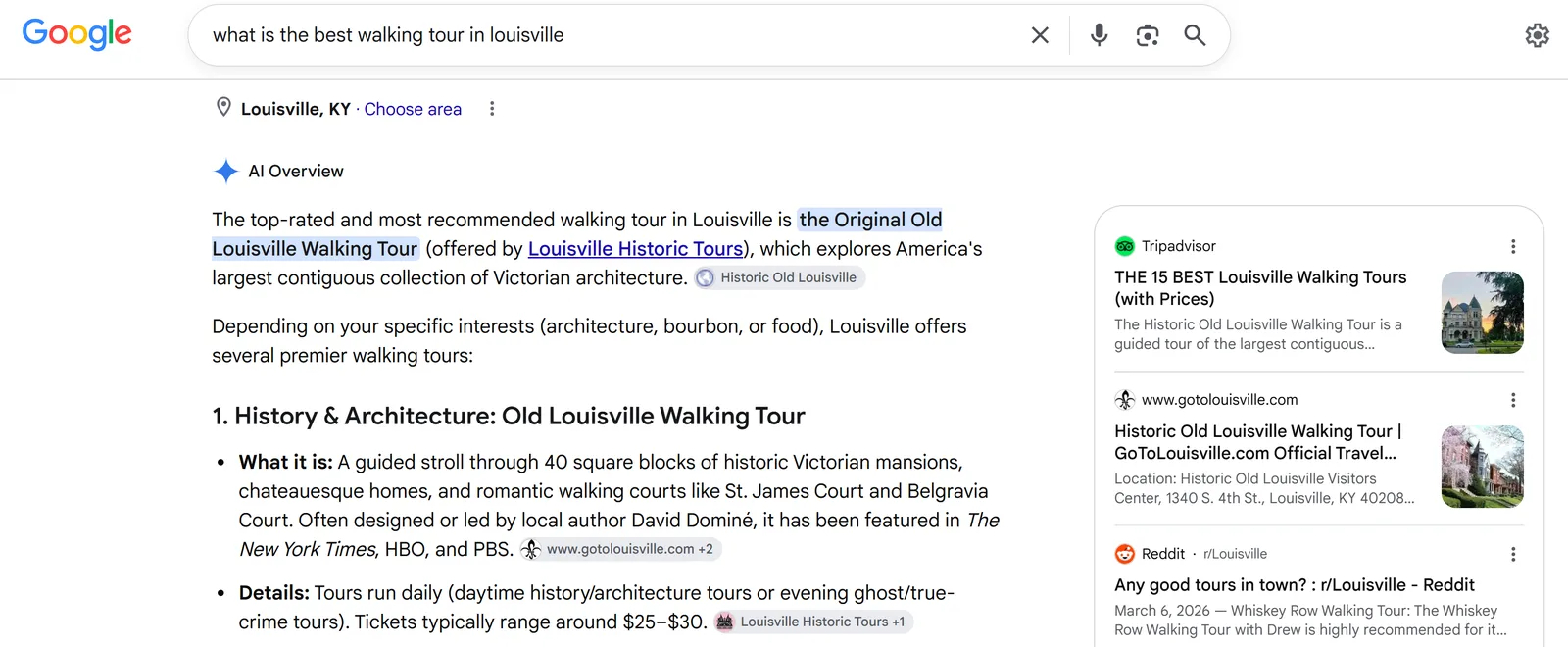
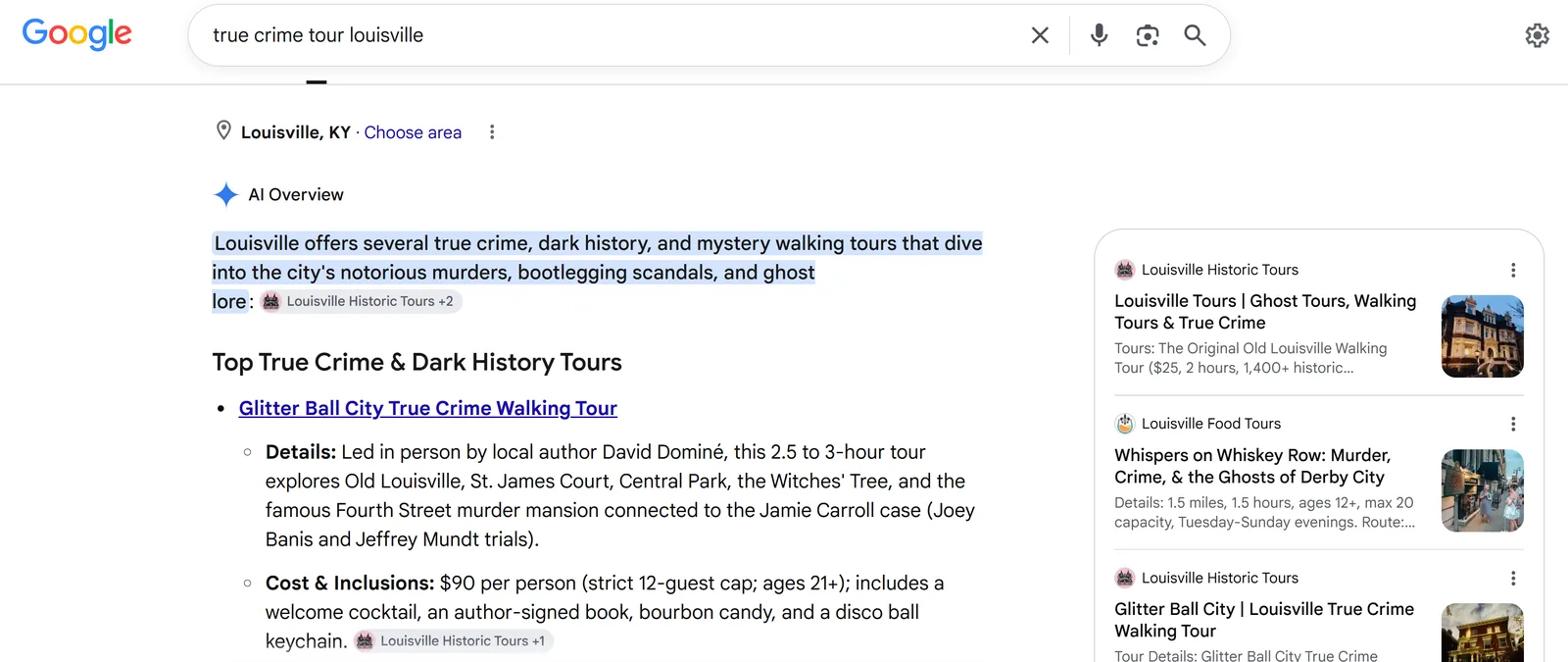
See all seven dated screenshots in the case study
A caution on expectations: no one controls what an AI assistant says, and answers change. What you can control is whether your pages are the clearest, most specific and most trustworthy source on the questions your customers ask.
Check where you stand in five minutes
- Ask ChatGPT, Perplexity and Google’s AI Mode: “Who is the best [your service] in [your city]?” Note who gets named
- Ask a question about one of your specific services. Is your page the source?
- Search your business name and compare the details Google shows with your website
- Look at your top service page. Could someone answer “how much, how long, where and who” from it in ten seconds?
- Check your general Schema.org markup with the Schema Markup Validator, then use Google’s Rich Results Test for Google-supported rich results. What structured data looks like
Want to know if AI can see you?
Our audit includes an AI visibility check alongside search and every path to a sale. $1,500, 5 business days.

Sean Stafford
Founder of Hunley Media Group. Co-founded El Toro and led TRIM NuLu’s rebuild as CEO. More about Sean